


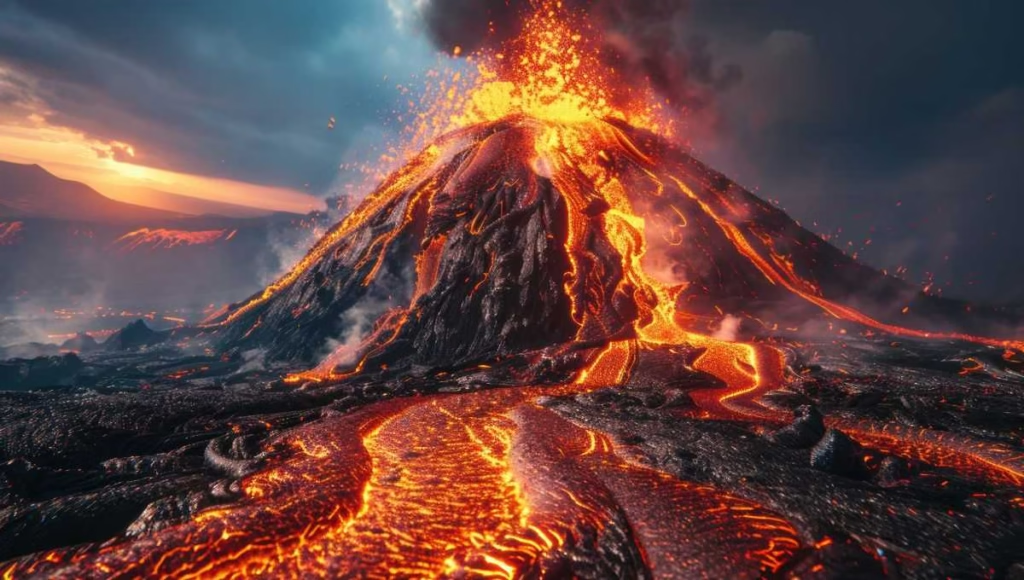
The Most Volcanoes in the World: Volcanoes are natural formations on Earth that bring out the deep heat and energy of our planet, spewing lava, ash, and gas. But the question is, which country has the most volcanoes? That is, where are “the Most Volcanoes in the World”? This analysis is based on a report published in Jagran Joshi.
Structure and Function of Volcanoes
Volcanoes are basically holes or cracks in the Earth’s surface from which magma (molten rock), gas, and ash come out.
This magma is located deep in the Earth’s crust, and when tectonic plates collide, collide, or subduct, the molten magma finds a way to rise to the surface.
This process is what causes volcanoes to form and erupt.
A large portion of the world’s volcanoes is located in an area known as the “Ring of Fire”, a large belt that surrounds the Pacific Ocean and is one of the most active volcanic regions on Earth.
Which countries have “the Most Volcanoes in the World”?
According to Jagran Josh, the top list of countries with the most active volcanoes is as follows:
Indonesia
Jagran Josh reports that Indonesia has more than 120 active volcanoes.
Indonesia’s position is very dynamic, as it is located at the junction of three large plates: the Indo-Australian Plate, the Pacific Plate, and the Eurasian Plate.
These plates are colliding or subducting, causing frequent volcanic eruptions, earthquakes, and geological changes. Major volcanoes such as Merapi, Krakatoa, and Tambora have a history of being very powerful and influential.
Japan
Japan also has more than 100 active volcanoes, reports Jagran Josh.
Because Japan is located at the intersection of four major tectonic plates—the Eurasian, Philippine, Pacific, and North American plates—it is very active from an earthquake and volcanic point of view.
The country’s most famous volcano is Mount Fuji, but other active and well-known volcanoes are of great importance for tourism, geothermal energy, and the population.
United States
There are about 65 active volcanoes in the United States, most of which are in Alaska.
Alaska is geologically very active, and shield volcanoes in Hawaii slowly release lava flows, which form new land. The United States also has dangerous volcanoes, such as Mount St. Helens, which erupted violently in 1980.
Russia
There are about 30 active volcanoes on the Kamchatka Peninsula in Russia, as mentioned in the Awakening Joshi.
The region is located on the subduction zone of the Pacific Plate, and its geology supports the formation of very high and explosive volcanoes.
The volcanoes of Kamchatka are surrounded by geysers, hot springs, and other geographically interesting areas, which are of great importance to scientists.
Chile
Chile has more than 90 active volcanoes within the Andes Mountains, according to the Jagran Josh report.
These volcanoes are caused by the subduction of the Nazca Plate, which is under the South American Plate and forms volcanoes.
Famous volcanoes in Chile include Villarrica and Llaima. These mountains are active from time to time, emitting lava fountains, hot smoke, and gases.
Why are these countries also considered “the Most Volcanoes in the World”?
Of the above countries, Indonesia, Japan, and Chile are particularly important from the perspective of “the Most Volcanoes in the World”, because:
- Geographical location: These countries are in areas where the convergence, subduction or divergence of tectonic plates work very deeply. For example, both Indonesia and Chile are located in subduction zones.
- High activity: Not only the number of volcanoes, but also their level of activity is important. These countries have frequent eruptions, hot springs, earthquakes, etc.
- Natural effects: Volcanoes form new land (such as lava fields), create fertile soil, and sometimes affect the global climate.
- Socio-economic effects: Human habitation, tourism, and energy production (geothermal energy) are created around these volcanoes.
Some interesting facts and facts about volcanoes
- New land formation: Lava from volcanoes gradually solidifies to form new rocks and can create new land.
- Fertile soil: Volcanic ash and powdery residue contain minerals such as potassium, calcium, iron, etc., which make the soil very fertile.
- Climate effects: Large eruptions can spray gases and ash into the atmosphere, which can block sunlight and temporarily lower global temperatures. For example, the 1815 eruption of Mount Tambora caused the “Year Without a Summer”.
- Marine volcanoes: Surprisingly, more than 80% of the world’s volcanoes are under the sea.
These types of volcanoes form mid-ocean ridges and can sometimes even create new islands.
Read more:- Death Valley: Life Inside The Hottest Place on Earth
“The Most Volcanoes in the World”: Basic Meaning and Importance
“The Most Volcanoes in the World” generally refers to countries where the number of volcanoes is high, and especially the presence of active volcanoes is highly relevant in terms of nature, structure, impact, and risk. According to Jagran Joshi’s report, Indonesia, Japan, the United States, Russia, and Chile are at the top of this list.
The quality and scale of volcanoes in these countries are not only important from a geographical or geological point of view, but also have an impact on human life and economy. “the Most Volcanoes in the World”, this concept reminds us that the energy inside the Earth (magma, plate motion) has not only shaped the land, but also has a profound impact on life.
Are there any challenges or security risks in the future?
Volcanic eruptions are always a danger signal; dense ash, gas emissions can endanger life, agriculture, and the environment.
Earthquakes, volcanic activity, and plate motion can influence each other, which points to major changes in the future.
But on the bright side, many countries are now monitoring volcanic activity, developing warning systems, and even planning to harness volcanic energy (such as geothermal energy).


Hi readers. I’m Piyali Batabyal, a passionate blogger who loves to share her thoughts, ideas, and experiences across a variety of topics—from lifestyle and beauty to personal growth and creativity. With a curious mind and a love for words.
Alongside my writing, I am also a professional makeup artist with a flair for enhancing natural beauty and creating transformative looks.