
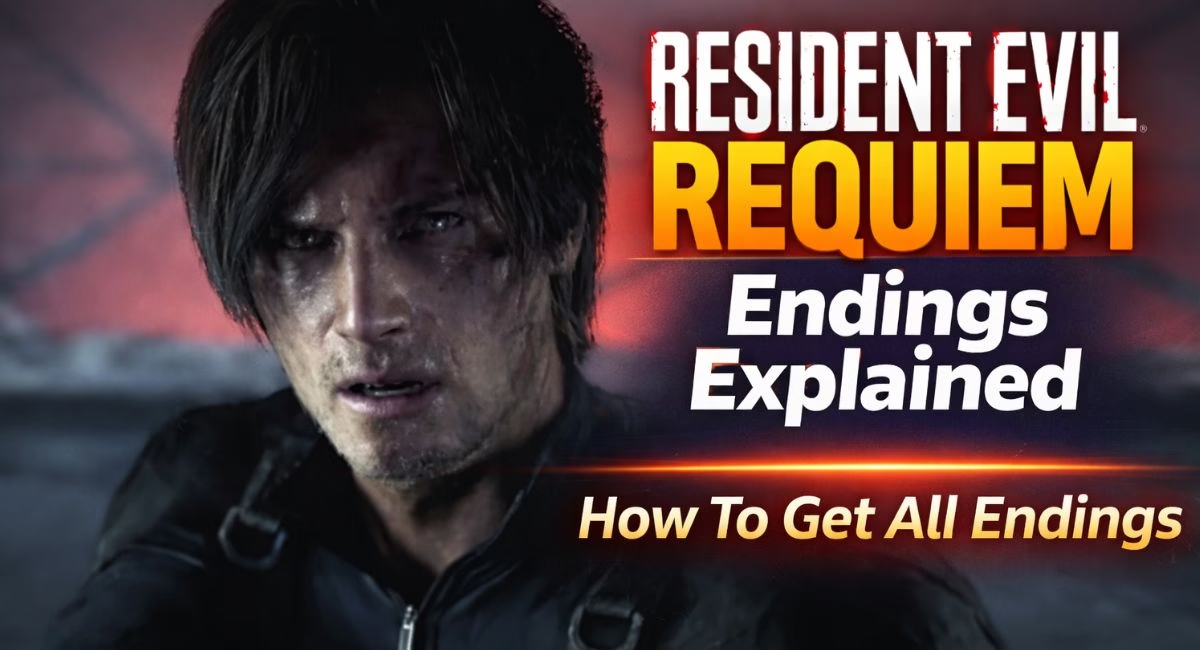
Few survival horror titles in recent memory have generated as much discussion around narrative outcomes as Resident Evil Requiem Endings. While the game delivers tense combat, resource management, and cinematic storytelling, it’s the branching conclusions that leave players debating long after the credits roll.
Unlike traditional entries where the ending variation might hinge on performance rank, Resident Evil Requiem builds its conclusions around meaningful decisions, character relationships, and hidden story triggers. Whether you reached the Hope ending, the Destruction route, or the elusive Elpis conclusion, each path reveals different truths about the outbreak and its aftermath.
This comprehensive guide breaks down every ending, how to unlock them, and what they mean for the franchise’s broader narrative.
Resident Evil Requiem: Core Game Overview
Before diving into the endings, understanding the game’s foundation is essential.
Resident Evil Requiem blends classic survival horror mechanics with modern cinematic storytelling. The game follows a protagonist navigating a quarantined city devastated by a bioweapon catastrophe tied to a rogue research faction.
Key Gameplay Specs
- Genre: Survival Horror
- Perspective: Third-person over-the-shoulder
- Platforms: PlayStation 5, Xbox Series X|S, PC
- Average Playtime: 12–18 hours (first run)
- Multiple Endings: Yes (Three primary conclusions)
- Combat: Tactical shooting with limited resources
- Exploration: Semi-open environments with branching paths
- Difficulty Modes: Assisted, Standard, Hardcore
Unlike purely linear entries, Resident Evil Requiem integrates narrative variables influenced by player choices. Dialogue decisions, rescue attempts, optional objectives, and late-game moral calls determine which ending you receive.
How Many Endings Are in Resident Evil Requiem?
There are three primary endings:
- Hope
- Destruction
- Elpis (True Ending)
Each one reflects not only the final decision but your cumulative choices throughout the campaign.
Importantly, unlocking certain endings may require specific side objectives and character survival conditions.
Hope Ending Explained
The Hope ending is often the most commonly achieved on a first playthrough.
How To Unlock the Hope Ending?
To trigger this route, players must:
- Preserve key survivor NPCs throughout the story.
- Complete at least two optional rescue objectives.
- Avoid aggressive or retaliatory dialogue options in critical late-game conversations.
- Choose containment over annihilation during the final decision.
In the climax, the player is given a choice regarding the fate of the infected zone. Selecting the controlled containment protocol rather than full-scale destruction sets the Hope outcome in motion.
What Happens in the Hope Ending?
The protagonist successfully activates a targeted containment system that neutralizes the infection without eradicating the entire region.
Key survivors escape.
Government forces establish quarantine.
Evidence of the rogue research faction is preserved for exposure.
The final cutscene shows rebuilding efforts beginning, though subtle hints suggest remnants of the bioweapon strain may still exist.
Thematic Meaning of Hope
This ending emphasizes:
- Accountability over erasure
- Saving lives when possible
- Transparency in exposing corruption
It’s the most optimistic conclusion, though it leaves narrative threads open for potential sequels.
Destruction Ending Explained
The Destruction route is darker and often triggered by more aggressive gameplay decisions.
How To Unlock the Destruction Ending?
Players typically reach this ending if they:
- Fail to rescue certain NPCs.
- Ignore optional side objectives.
- Choose lethal or confrontational dialogue options.
- Select total eradication during the final choice.
If the player opts to detonate the full city-cleansing protocol, Destruction is locked in.
What Happens in the Destruction Ending?
The city is obliterated to prevent further spread of the infection.
While the outbreak is fully contained, civilian casualties increase.
Critical research evidence is lost.
The protagonist survives but carries visible emotional weight.
The closing scene implies the truth may never surface, and powerful entities avoid accountability.
Thematic Meaning of Destruction
This ending explores:
- Sacrifice versus morality
- The cost of decisive action
- Institutional secrecy
It’s effective but morally ambiguous, reflecting classic Resident Evil themes of collateral damage in the name of safety.
Elpis Ending Explained (True Ending)
The Elpis ending is widely regarded as the “true” or secret conclusion.
“Elpis” translates to hope in Greek, but within the game, it represents something deeper — a fusion of justice and preservation.
How To Unlock the Elpis Ending?
This route requires deliberate planning across the entire campaign.
Players must:
- Rescue all major NPCs.
- Complete every optional side investigation.
- Recover hidden data logs exposing the research faction.
- Maintain neutral or empathetic dialogue responses.
- Preserve key scientific evidence.
- Choose containment while also activating a failsafe override discovered in a hidden lab.
The failsafe override is easily missed. It requires accessing a secondary underground facility during Chapter 9 — something only available if earlier data fragments were collected.
What Happens in the Elpis Ending?
In this version:
- The outbreak is contained with minimal casualties.
- The rogue faction’s crimes are publicly exposed.
- Surviving scientists assist in developing countermeasures.
- The protagonist steps into a public whistleblower role.
Unlike the other endings, Elpis resolves the outbreak while reshaping global bioweapon policy.
The final scene teases a new alliance dedicated to preventing future catastrophes.
Key Decision Points That Affect Endings
Resident Evil Requiem hides several branching triggers throughout the campaign.
1. Hospital Evacuation Sequence
Rescuing trapped survivors affects later narrative support.
2. Research Facility Data Retrieval
Missing data logs block access to the Elpis path.
3. Confrontation With Dr. Virelli
Dialogue tone impacts alignment tracking.
4. Final Reactor Core Choice
The most obvious branching moment, but only impactful if prior conditions are met.
Players often assume only the final choice matters — but internal alignment tracking begins much earlier.
Performance Rank vs Narrative Outcome
Unlike older titles where rank influenced post-credit scenes, Resident Evil Requiem focuses more on narrative choices than speedrun performance.
However:
- Completing optional objectives increases story flags.
- Higher exploration rates unlock additional cutscenes.
- Hardcore difficulty does not directly alter endings.
Your decisions matter more than your completion time.
Replay Strategy: How To Get All Endings Efficiently?
If you want all Resident Evil Requiem Endings in minimal playthroughs:
- First Run: Play naturally and aim for Hope.
- Second Run: Skip rescues and choose aggressive options for Destruction.
- Third Run: Follow a completionist checklist for Elpis.
New Game Plus helps significantly:
- Carry over weapons.
- Faster exploration.
- Easier hidden item retrieval.
Expect approximately 35–45 hours total to experience all endings fully.
Narrative Depth and Franchise Impact
Resident Evil Requiem marks a shift toward morally driven branching conclusions. Rather than simply surviving, players shape the ethical outcome.
The Elpis ending in particular suggests potential long-term franchise evolution, focusing on prevention rather than recurring outbreaks.
This narrative design increases replayability while encouraging player accountability.
Technical Performance and Game Specs
For players concerned about performance:
PC Recommended Specs
- CPU: Intel i7 / Ryzen 7 equivalent
- RAM: 16GB
- GPU: RTX 2060 or higher
- Storage: 50GB SSD recommended
Console Performance
- PS5 / Xbox Series X:
- 4K dynamic resolution
- 60 FPS performance mode
- Ray tracing support
Smooth performance enhances immersion, especially during intense branching finale sequences.
Why Multiple Endings Matter in Survival Horror?
Branching conclusions deepen emotional investment. When outcomes reflect your actions, tension increases.
Resident Evil Requiem doesn’t just challenge reflexes — it challenges ethics.
That shift signals maturity in survival horror storytelling.
Choice Defines Consequence
The brilliance of Resident Evil Requiem Endings lies in their design philosophy. The game doesn’t reward perfection — it rewards intention.
Whether you choose containment, destruction, or systemic reform, each outcome reflects your moral stance within a collapsing world.
For longtime fans of survival horror, this layered narrative approach elevates Resident Evil Requiem beyond a standard action-horror experience.
And if you thought one playthrough was enough, think again.
FAQs
How many endings are in Resident Evil Requiem?
There are three primary endings: Hope, Destruction, and Elpis.
What is the true ending in Resident Evil Requiem?
Elpis is widely considered the true ending because it requires completing all major objectives and reveals the most narrative closure.
Does difficulty affect the ending?
No. Difficulty changes combat challenge but does not directly influence which ending you receive.
Can you get all endings in one playthrough?
No. Each ending requires different choices and actions across the campaign.

Hi readers. I’m Piyali Batabyal, a passionate blogger who loves to share her thoughts, ideas, and experiences across a variety of topics—from lifestyle and beauty to personal growth and creativity. With a curious mind and a love for words.
Alongside my writing, I am also a professional makeup artist with a flair for enhancing natural beauty and creating transformative looks.