
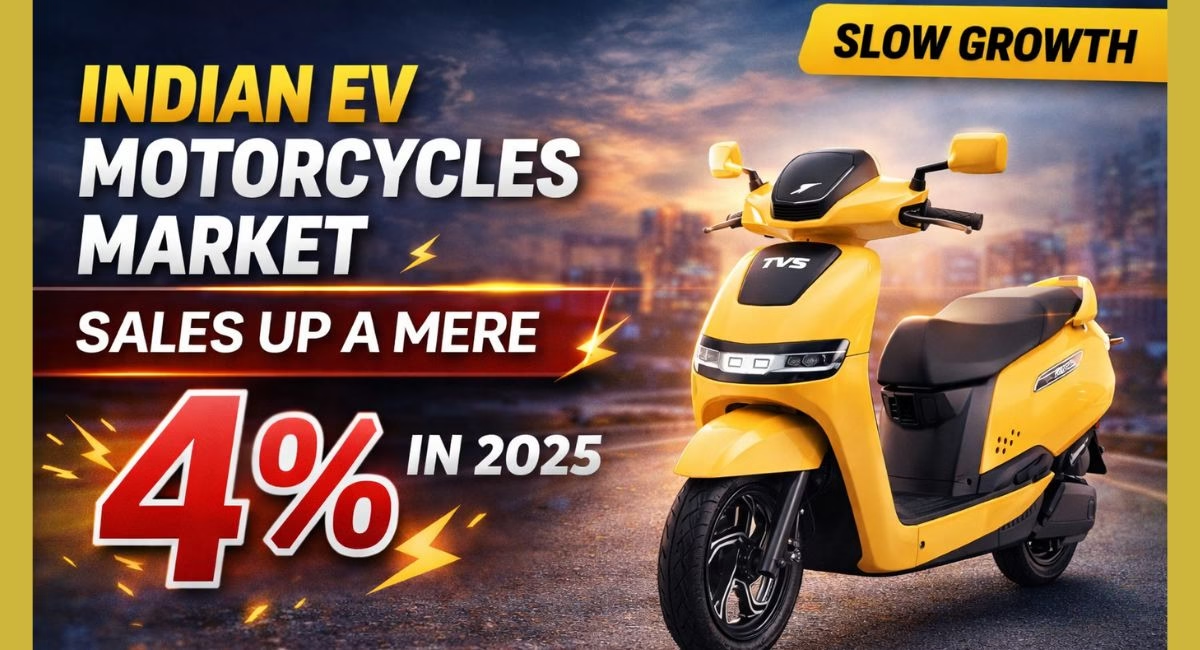
India’s electric mobility story has often been framed as a high-speed revolution. Over the past few years, electric scooters and motorcycles have gained visibility, venture funding has poured into startups, and government incentives have pushed adoption forward. Yet, 2025 delivered a surprising development: Indian EVs Motorcycles sales reportedly grew by just 4% year-on-year.
For an industry once growing in double digits, this modest rise signals a moment of reassessment.
Is the market slowing down? Has demand peaked? Or is this simply a transitional phase before the next wave of innovation?
In this comprehensive report, we break down what the 4% growth figure truly means, examine technical specifications shaping buyer decisions, analyze infrastructure and policy challenges, and explore where Indian EV motorcycles may head in 2026 and beyond.
Understanding the 4% Growth: Context Matters
At first glance, a 4% growth rate seems underwhelming. However, interpreting this number requires perspective.
Over the past three years:
- 2022 saw explosive growth due to subsidy support.
- 2023 experienced strong momentum with new brand entries.
- 2024 began stabilizing as early adopters were saturated.
By 2025, the market appears to have entered a consolidation phase.
Growth slowing does not necessarily mean decline. Instead, it may signal:
- Maturing consumer awareness
- Pricing corrections
- Policy adjustments
- Infrastructure bottlenecks
The Indian EVs Motorcycles market is transitioning from hype-driven adoption to practicality-driven purchasing.
Key Sales Drivers in 2025
Despite modest growth, several underlying factors influenced performance:
1. Subsidy Adjustments
Government incentive revisions affected pricing structures. Lower subsidies directly impacted entry-level EV affordability.
2. Rising Competition
More brands entered the market, fragmenting demand rather than expanding it significantly.
3. Infrastructure Gaps
Charging network expansion did not keep pace with vehicle sales growth, especially in tier-2 and tier-3 cities.
4. Consumer Caution
Battery fire incidents in earlier years created cautious sentiment among some buyers.
Market Composition: Scooters vs Motorcycles
While scooters continue to dominate India’s electric two-wheeler market, electric motorcycles are gradually increasing their share.
Scooters appeal primarily to:
- Urban commuters
- Delivery fleets
- Students
Electric motorcycles attract:
- Enthusiasts
- Highway commuters
- Riders upgrading from petrol bikes
However, motorcycle adoption has grown slower compared to scooters due to higher pricing and limited model variety.
Read more:- Ai+ Expands Its Ecosystem: NovaPods and NovaWatch Signal a Bold New Chapter in Smart Audio and Wearables
Technical Specifications Shaping Buyer Decisions
Understanding Indian EVs Motorcycles requires examining the core technical factors that influence purchases.
Battery Capacity
Most electric motorcycles in India offer:
- 3 kWh to 5 kWh battery packs
- Lithium-ion chemistry
- Detachable or fixed battery configurations
Higher-capacity batteries provide:
- 120–180 km real-world range
- Improved highway usability
However, they also increase cost and weight.
Motor Power Output
Electric motorcycle motors typically range between:
- 3 kW to 10 kW continuous power
- Peak power outputs reaching 12 kW+
Performance-focused models offer:
- 0–60 km/h in under 4 seconds
- Top speeds between 85–120 km/h
For many Indian buyers, top speed and acceleration remain key decision factors.
Charging Capabilities
Charging times vary based on battery size and charger type:
- Standard home charging: 4–6 hours
- Fast charging support (limited availability): 1–2 hours
The absence of widespread fast charging remains a major limitation.
Riding Modes
Most Indian EVs Motorcycles offer:
- Eco mode (range-focused)
- Normal mode
- Sport mode
These modes adjust power output and regenerative braking.
Smart Features
Modern electric motorcycles increasingly include:
- TFT instrument clusters
- Bluetooth connectivity
- Navigation integration
- Over-the-air updates
- Mobile app connectivity
Technology plays a significant role in attracting younger buyers.
Pricing: The Core Challenge
Affordability remains central to India’s two-wheeler market.
Electric motorcycles typically cost:
- ₹1.2 lakh to ₹1.8 lakh (ex-showroom)
In comparison, petrol motorcycles in similar performance brackets are often priced lower.
Even with lower running costs, higher upfront pricing discourages mass adoption.
Total Cost of Ownership (TCO)
Despite higher purchase prices, Indian EVs Motorcycles offer:
- Lower fuel cost (electricity vs petrol)
- Reduced maintenance
- Fewer moving parts
Estimated savings over five years can be substantial for daily commuters covering long distances.
However, buyers still prioritize upfront cost over lifetime savings.
Charging Infrastructure: The Bottleneck
India’s public charging network remains concentrated in:
- Metro cities
- Select highways
Rural and semi-urban areas lack adequate infrastructure.
For apartment residents without dedicated parking, home charging remains complicated.
This infrastructure gap directly impacts growth rates.
Government Policies and Their Impact
India’s electric mobility incentives have been instrumental in market growth.
Key policy components:
- Purchase subsidies
- Reduced GST on EVs
- State-level incentives
- Production-linked incentives for manufacturers
However, policy fluctuations create uncertainty.
Consistency in incentives is critical for stable growth.
Consumer Sentiment in 2025
Buyers in 2025 are more informed.
They ask:
- How long will the battery last?
- What is the replacement cost?
- Is resale value stable?
- Are spare parts available?
This shift from excitement to practical evaluation is natural in maturing markets.
Leading Trends in Indian EVs Motorcycles
Despite modest growth, innovation continues.
Trend 1: Improved Battery Management Systems
Manufacturers are investing in advanced thermal management to reduce overheating risks.
Trend 2: Modular Platforms
Shared EV platforms reduce manufacturing costs and allow faster model launches.
Trend 3: Fleet Adoption
Delivery services increasingly adopt electric motorcycles for cost savings.
Trend 4: Swappable Battery Models
Battery-swapping networks are expanding in select cities.
Regional Performance Differences
Urban centers like:
- Bengaluru
- Delhi NCR
- Pune
- Hyderabad
Continue to dominate EV adoption.
However, tier-2 cities are growing more slowly due to infrastructure and awareness gaps.
The Role of Startups and Established Brands
Startups initially drove EV motorcycle innovation.
However, established two-wheeler brands are now entering aggressively.
This shift increases:
- Competition
- Consumer trust
- Service network reliability
It may also compress margins and slow explosive growth rates.
Environmental Impact
Despite slower growth, EV motorcycles contribute significantly to:
- Reduced urban air pollution
- Lower carbon emissions
- Decreased noise pollution
India’s long-term electrification goals remain intact.
Why 4% Growth Is Not a Crisis?
A 4% rise suggests stabilization rather than stagnation.
Early growth phases often experience rapid expansion followed by consolidation.
In many industries, this pattern indicates:
- Market correction
- Sustainable long-term trajectory
- Elimination of weaker players
Indian EVs Motorcycles are entering a phase where quality and reliability matter more than hype.
What Could Accelerate Growth Again?
Several factors could re-ignite momentum:
- Improved battery affordability
- Faster charging infrastructure rollout
- Lower production costs through localization
- Stronger warranty programs
- Innovative financing models
If battery prices fall significantly, electric motorcycles could achieve cost parity with petrol models.
Outlook for 2026 and Beyond
Industry projections suggest moderate recovery in 2026, driven by:
- New model launches
- Better battery density
- Wider rural penetration
- Policy stability
Indian EVs Motorcycles remain strategically important to India’s climate goals.
Short-term moderation does not undermine long-term potential.
The Indian EVs Motorcycles market in 2025 delivered a sobering yet meaningful signal. A 4% growth rate reflects transition rather than decline.
The industry is moving from expansion driven by subsidies and early adopters to a more balanced, sustainable phase shaped by performance, infrastructure, and affordability.
While short-term momentum may appear modest, the structural drivers of electrification—urbanization, environmental pressure, and technological progress—remain firmly in place.
The next chapter of Indian EV motorcycles will not be defined by speed of growth alone, but by quality of innovation and consumer trust.
In that respect, the journey is far from over.
FAQs
Why did Indian EVs Motorcycles grow only 4% in 2025?
Growth slowed due to subsidy adjustments, infrastructure gaps, rising competition, and cautious consumer sentiment.
Are electric motorcycles cheaper to maintain?
Yes. They have fewer moving parts and no engine oil changes, leading to lower maintenance costs compared to petrol motorcycles.
What is the average range of electric motorcycles in India?
Most models offer 120–180 km per charge under real-world conditions.
How long do EV motorcycle batteries last?
Battery life typically ranges from 5 to 8 years, depending on usage and charging habits.

Hi readers. I’m Piyali Batabyal, a passionate blogger who loves to share her thoughts, ideas, and experiences across a variety of topics—from lifestyle and beauty to personal growth and creativity. With a curious mind and a love for words.
Alongside my writing, I am also a professional makeup artist with a flair for enhancing natural beauty and creating transformative looks.